The Last Thing I Saw Clearly Was My
Grandson's Face... Until I Learned About
the Canaan Honey Trick for Eyes
Ancient biblical discovery from the land of "milk and honey"
is now being studied by Harvard researchers for its potential
role in supporting healthy vision as we age.
Watch Dr. Weigel's free educational presentation below
to understand the science behind this natural approach.
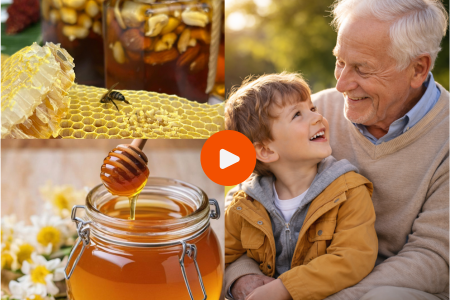
(Video may be removed at any time)
Why the Canaan Honey Discovery Matters
for Your Vision Health
Vision loss doesn't announce itself.
It arrives quietly.
At first, it's small things:
- → You hesitate before waving back to a neighbor
- → You blink twice to read a text message
- → You wonder if the lighting is just bad
Then something more unsettling happens...
You struggle to recognize faces from across the room.
You second-guess people you know well.
For a moment, you're uncertain:
or did I not remember them?"
Because it touches three things no one wants to lose:
- ✗ Independence
- ✗ Identity
- ✗ Connection with family
it's confusing vision problems with memory problems."
The 4 Stages of Vision Decline
(Which Stage Are You In?)
Most people don't "decide" to lose their vision.
They drift into it.
Here's how the progression typically unfolds:
STAGE 1: EARLY SIGNS
What You Notice:
- Occasional blur when reading
- Eyes get tired faster than before
- Need more light to see clearly
What's Quietly Happening:
- Early strain on eye cells
- Most people dismiss as "normal aging"
STAGE 2: INCREASING DIFFICULTY
What You Notice:
- Frequent squinting to focus
- Night driving becomes uncomfortable
- Light sensitivity increases
What's Quietly Happening:
- Eyes struggle to maintain sharp focus
- Visual fatigue becomes constant
STAGE 3: UNRELIABLE VISION
What You Notice:
- Difficulty recognizing faces at a distance
- Halos and glare around lights at night
- Vision feels inconsistent and unreliable
What's Quietly Happening:
- Visual signals becoming inconsistent
- Brain starts "filling in gaps" with memory
- Confusion between what you see vs. remember
STAGE 4: PROFOUND DECLINE
What You Notice:
- Trouble recognizing loved ones clearly
- Loss of confidence and independence
- Constant uncertainty about what you're seeing
What's Quietly Happening:
- Severe vision decline
- Daily activities become dangerous
- Quality of life significantly impacted
Important: If you're experiencing Stage 2 or 3 symptoms, Stage 4 can progress faster than most people expect.
The good news: understanding what's happening is the first step toward making informed decisions about your vision health.
What Others Are Saying About
This Presentation
"I've been to 5 different eye doctors over the past 10 years. Not one of them ever mentioned what Dr. Weigel explains in this video. I finally understand what's been happening to my eyes."
"As a retired nurse, I was skeptical. But the research Dr. Weigel references from Harvard and Oxford is legitimate. I looked it up myself. This information should be common knowledge."
"Finally, someone explained WHY my vision keeps getting worse every year despite new glasses. The 4-stage progression chart hit home. I'm in Stage 3 and didn't even know it had a name."
Presentation Statistics:
Why This Presentation May Not Be
Available Much Longer
Dr. Weigel's presentation discusses natural approaches that challenge conventional optometry practices.
Because of this, there has been pressure from certain industry groups to limit public access to this information.
While the content is 100% educational and backed by published research, we cannot guarantee how long this presentation will remain publicly available.
Important Notice
This presentation is currently available for free educational purposes. However, due to ongoing discussions about content restrictions in the health education space, we recommend watching it now if you're interested in learning more about natural vision support.
Ready to Understand What's Really
Happening to Your Vision?
If you've been struggling with declining vision...
If you're tired of getting new glasses every year without real improvement...
If you want to understand the science behind this natural approach that's helping thousands...
Then this presentation is for you.
Watch Dr. Weigel's Free Presentation NowFeatured Research Institutions
Frequently Asked Questions
It refers to a natural discovery from rare honey varieties in the biblical land of Canaan. Recent research from Harvard and Tokyo University has identified unique properties that may support healthy eye function. Dr. Weigel's presentation explains the complete science in detail.
No. This is educational content only. Dr. Weigel presents published research and natural health information. Always consult your doctor before making any health decisions.
Approximately 45 minutes. We recommend watching without distractions to fully understand the science.
No. The presentation is 100% free. No email, no credit card, no signup required.
Yes. The presentation references peer-reviewed studies from Harvard Stem Cell Institute, University of Tokyo Vision Research Lab, Oxford Ophthalmology Department, and Johns Hopkins Medical School. All citations are provided.